Texts
Ontological Inquiry through Abstraction and Stratification
2014.11
Lim San | Professor, Department of Curatorial Studies, Dongduk Women’s University
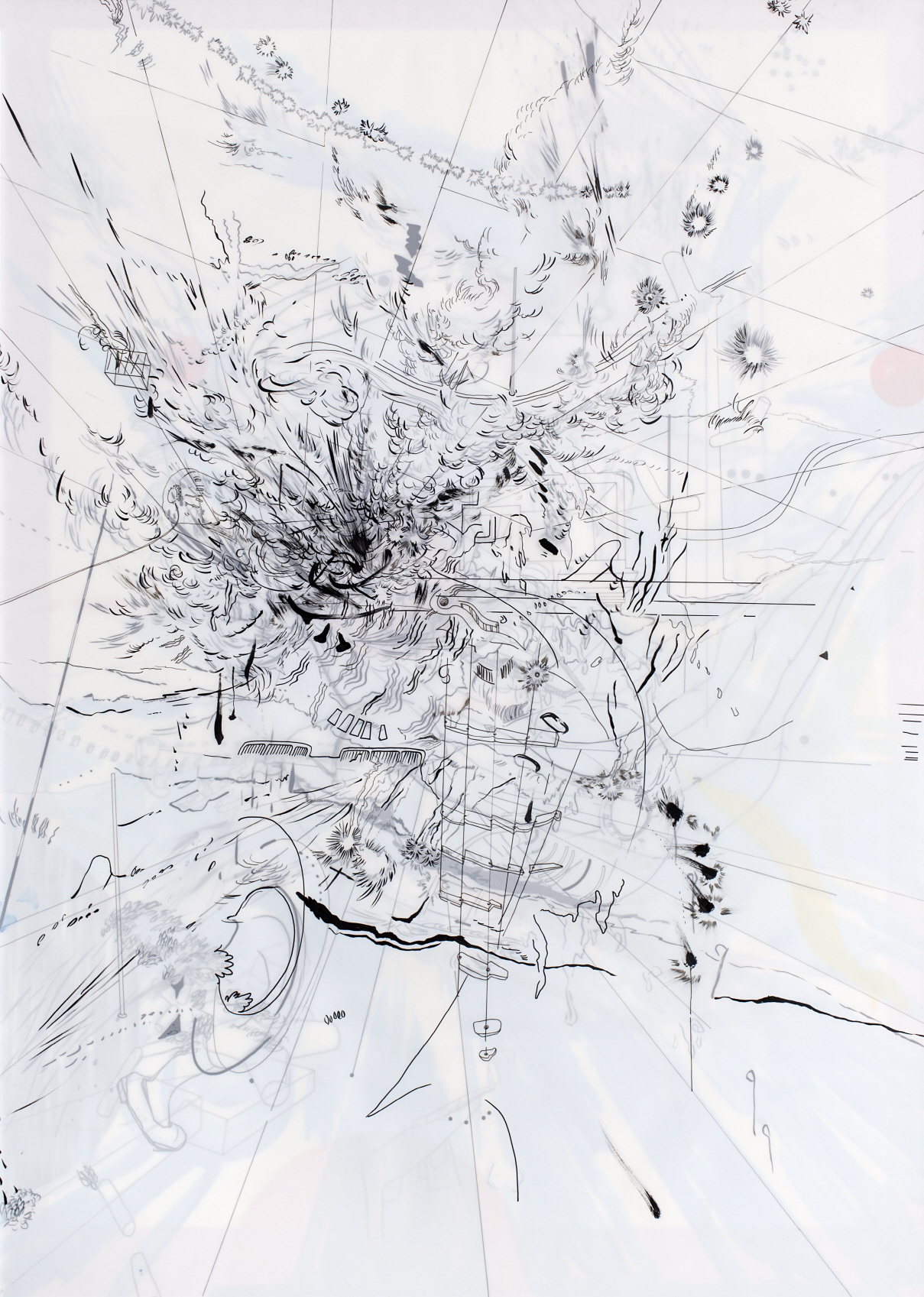
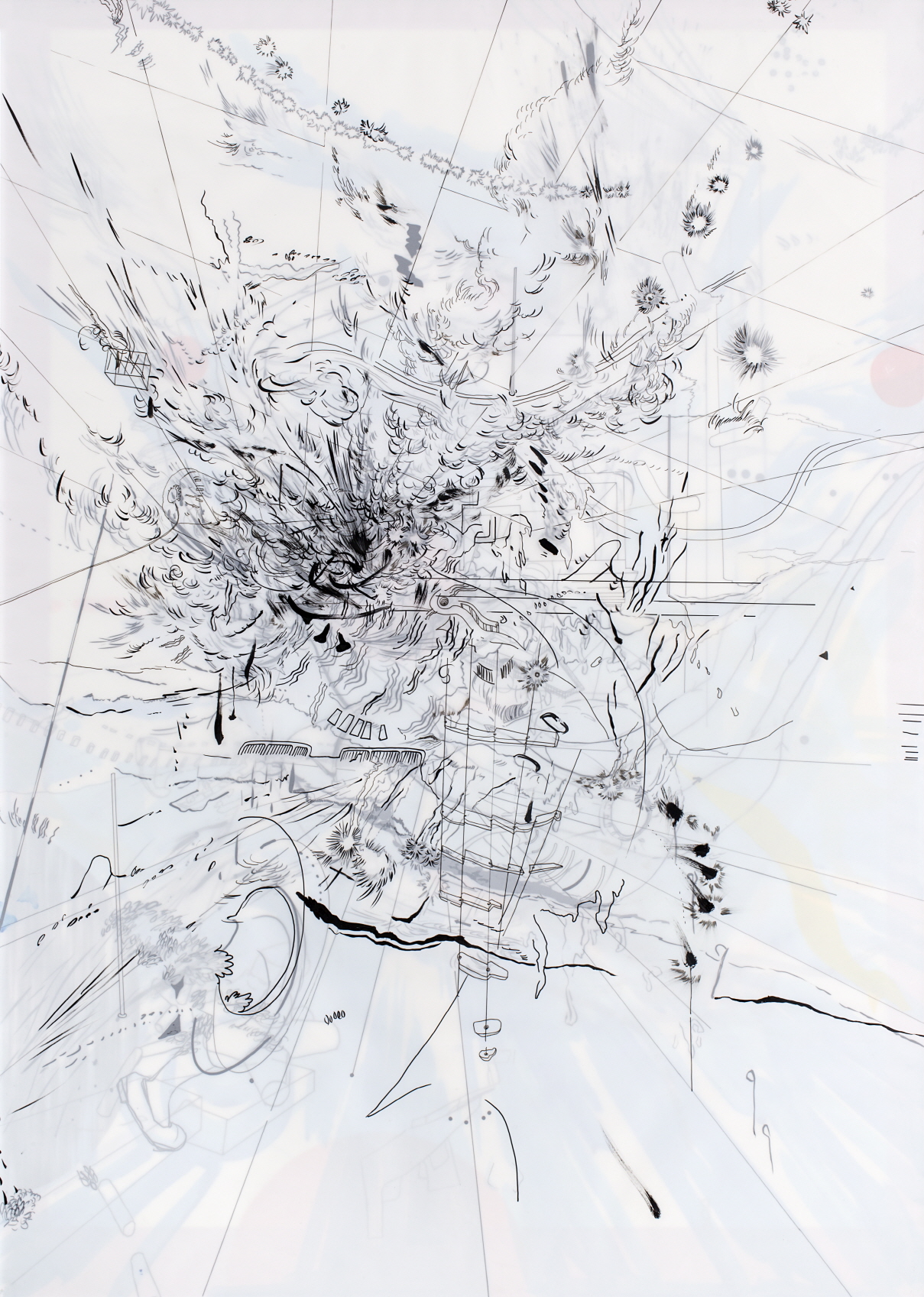
Heartrending landscape, 2014, Acrylic, Color pencil, pigment pen, Collage on color paper & tracing paper, 109 x 78 cm ©Artist
In the course of a life defined by movement (移動), repeatedly encountering disappearance and emergence, the artist’s body—having accumulated and retained the records and emotions of those moments—has itself become a canvas. Rather than being adept at reviving and expressing such sensations through deliberate gestures, it is a body that has become capricious, filled with indistinct images, and bound to an unknowable spatio-temporality.
The canvas, saturated with fragments of disparate moments from the past, comes to form a totality, functioning almost as the primary driving force that constitutes the artist’s own identity. This is because the consciousness (意識) of movement causes the innumerable passing lives and things to accumulate, layer upon layer, within the artist’s body and upon the canvas, where they continue to stir. The journey of this identity, having passed through a tunnel of time, multiplies the very particles that compose the body and arranges them within the depth of pictorial space.
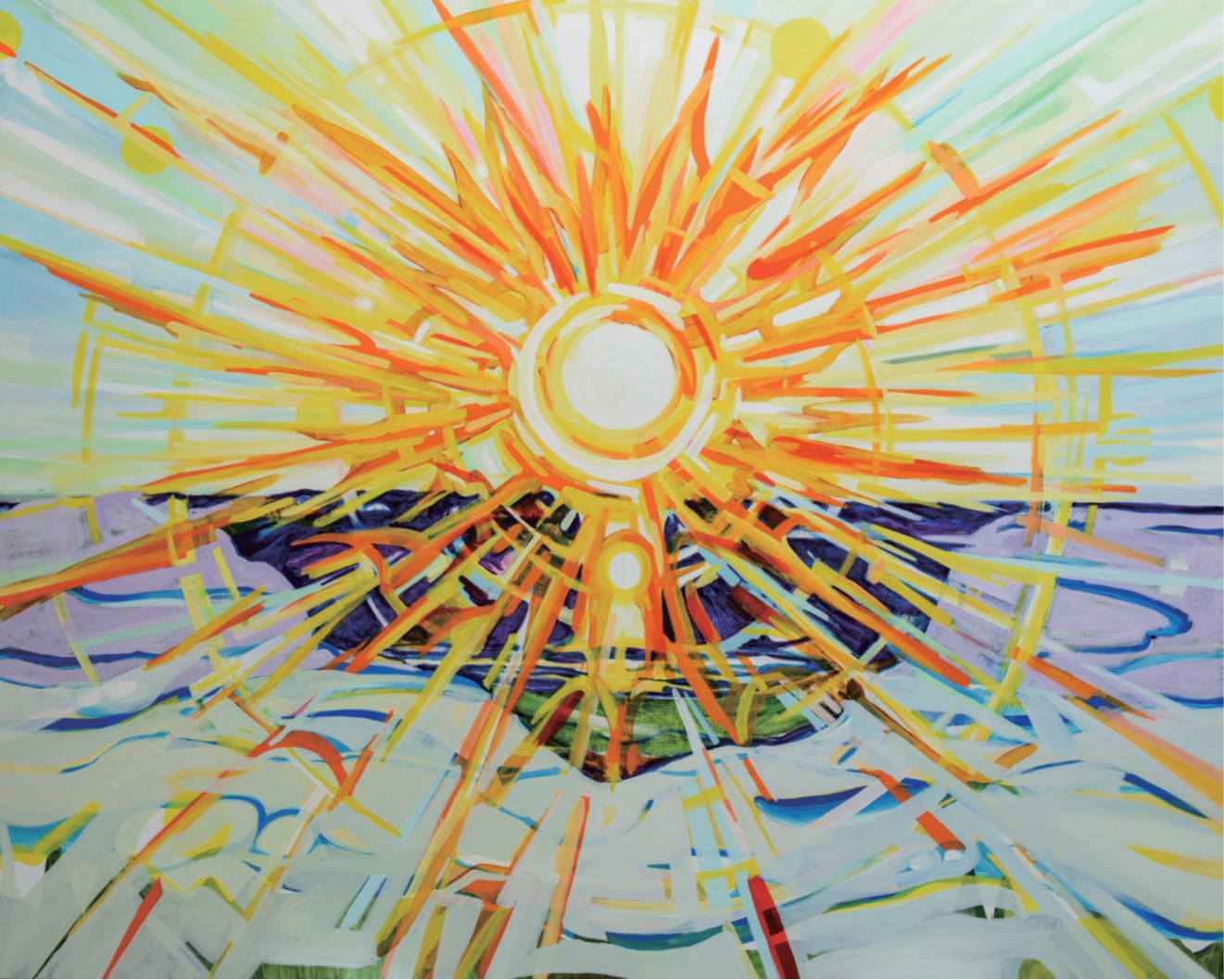
In the paintings of Huh Jeong-Won, it is not easy to discern a technique of symbolism. During her movement along the Gangneung–Seoul highway, she photographed the exterior landscape from within a moving vehicle. These produced images serve as the primary raw material of her paintings, yet they are not schematized into simple landscapes. Rather, the serial images gather the plenitude of the world itself, standing in for her journey.
Nevertheless, these by-products of consciousness cease to remain as literal pictorial texts and become abstracted. This constitutes a defining characteristic of Huh Jeong-Won’s landscape painting, which distinguishes itself from conventional landscape traditions that either establish a “center” (the artist capturing the scene through a lens) and schematically transform the “periphery” (槪略), or else foreground, in an explicit manner, those peripheral elements that fall within the visible range of the center while refusing the indeterminacy of a labyrinthine space.
Then where does the reason lie for Huh Jeong-Won’s abstraction of the spatio-temporality (時空) of landscapes that drift within her consciousness? While it may be inferred from the expressive characteristics of her landscape practice discussed above, it ultimately stems from an intention not to confine the products of her consciousness within the guise of a conventional universality, under the pretext of resolving the theme of identity.
In general, the process of affirming identity within the human world tends to secure its legitimacy by assimilating another defeated “self” into the victorious “self” through countless ontological struggles. However, Huh Jeong-Won resists granting any hierarchy within the pictorial field between what remains at the end of the reproduction of consciousness and those elements belonging to the “periphery.” This is all the more significant given that a universality accompanied by certain sacrifices, in the process of seeking identity, inevitably follows the conventional logic of landscape painting that harbors the Other within the scene.
Thus, Huh Jeong-Won’s abstraction is not merely a methodological gaze aimed at overcoming the unavoidable limitations of the painter—limitations revealed in the attempt to summon time beyond the reach of the naked eye. Rather, her refusal to leave within the frame of reality that which she had once secured from everyday life for the sake of creation implies a reconfiguration of the relationship between herself and the materials that inhabit her daily existence.
This emerges as a result of her aesthetic intuition, which recognizes the futility of repetition and transforms her nomadic (遊牧的) mode of existence into an impetus for qualitative change in life. It begins, first and foremost, with the erasure of images that had initially been accepted into the canvas. Through this process of abstraction (抽象), one arrives at the core of existence, which can no longer be understood as absence (不在).

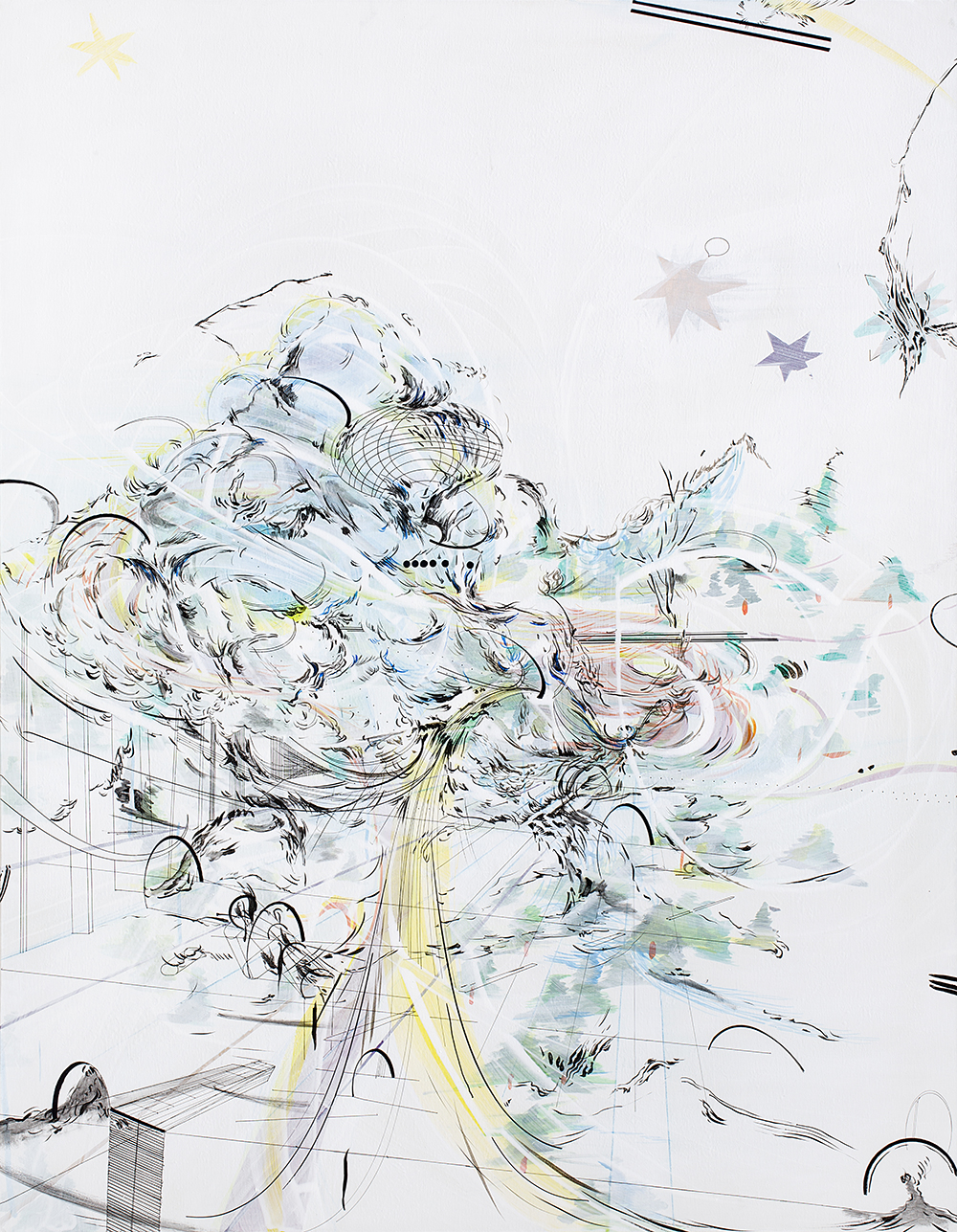
In between going up and down, 2014, Acrylic, Color pencil, pigment pen, pencil, Collage on tracing paper, 39.5 x 54.5 cm ©Artist
Drawing upon those elements that accompanied her along the paths of movement, and channeling the life of movement through them, her abstraction refines these companion images from the density of reality. Within Huh Jeong-Won’s paintings, where the waves of such abstraction resonate, there lies an enigmatic layering that gathers together fragments of the scattered world in order to respond to it. The formal technique for this is based on a layered method employing trepal paper. Within the completed painting, previously rendered images remain as strata, forming multiple layers.
Each image unfolded within these layers represents the experience of thought moving toward yet another destination, as well as a fluid identity. However, due to the materiality of trepal paper, the ontological connections between layers are partially concealed—appearing and disappearing at once. Yet for Huh Jeong-Won, concealment itself can signify an ultimate mode of “revealing.” This ontological approach recalls Martin Heidegger’s notion of “unconcealment as clearing (Lichtung),” through which her faint and delicate paintings come to appear, paradoxically, all the more distinct.
To connect the processes of concealment and unconcealment in this way, in order to convey her nomadic existence, can be understood as a means of ultimately summoning the experiential encounters of being that were shared with those landscapes lying silent within the layered structure. The singularity of being that viewers encounter when they integratively read the other dimensions beyond the layers reveals itself only through a process akin to what, again borrowing from Heidegger, may be called a kind of “play (Spiel).”
Yet, the artistic struggle to find the “self” that is glimpsed—or proposed—within Huh Jeong-Won’s paintings does not resemble the anxious act of preserving oneself within the accelerating constraints of a Tetris-like structure; rather, it exists in the productive activity of play that leads what is hidden toward a state of unconcealment. In this sense, her layers exist as moments of suspension from the past, while simultaneously operating as the present of truth’s articulation.
Ultimately, the forms of abstraction and layering in her work constitute an attempt to allow the landscapes encountered along the paths of movement, and the reflections on being that arise from them, to first remain as they are. Thereafter, by simultaneously concealing and revealing these landscapes, they function as a means of sustaining an inquiry that seeks to fully recover the “self” in relation to the world. We often define our identity by relying solely on the belief that we possess the secret of being. But can such a belief alone complete a contemplation of the truth of essence? Her landscapes compel us to pursue this very question.
Interestingly, the abstraction and layering she employs belong to artistic forms that are among the least constrained by the authority of traditional representational painting. For this reason, her paintings do not offer familiar modes of visual guidance. Yet, through this choice of form, we encounter a possibility of art that strives to approach the secret of being. Her exploration of existence through landscape is less a civilizational critique that plans and enacts the self, and closer to an aesthetic reflection that ultimately transforms the depth of perception experienced by the body into something that must be painted. This is why her paintings—at once resembling observation and reflection—do not remain mere alibis of time and space.
At the beginning of this text, the author compared Huh Jeong-Won’s canvas to her body. The body bears the inscription of the depth of life. Rather than preparing for the future or promising a form of liberation, her art lucidly reexamines the ordinariness and material sensations of everyday life that the body commemorates. By accumulating, adding, and juxtaposing images, it cites the qualities and meanings of the past. To understand the unmediated circulation and inner value of the body, one must be able to perceive its original texture; thus, her exploration of being demands a dynamic and multidimensional imagination capable of unfolding the complexity of the body’s delicate organs. From her paintings, we discover the restorative force of that complexity, which the body senses “Like caresses in the wind.”
Writings